


Rear Admiral Greg Slavonic, USN (Ret.)
Edmond Sun
EDMOND — The same month that Congress cut $1 trillion from the defense budget, satellite photos revealed that blackened holes had replaced two buildings at a remote Iranian military facility.
According to analysts, the blast indicates that Iranian rocket scientists are working on a breakthrough in new missile technology, likely to target Israel, Europe, or even the U.S. mainland. The event came just weeks after a United Nations report that Iran has accelerated its drive to develop nuclear weapons. Experts say all signs point to Iran’s race to build a nuclear ballistic missile.
Yet the unprecedented defense cuts put into motion by the debt ceiling deal would drain funding for the most essential elements of our national security, including U.S. missile defenses that are our only physical protection from nuclear ballistic missile attack. It’s like pawning your raincoat just as the first thunderclaps break over a darkening sky. The terrible timing has national security experts howling.
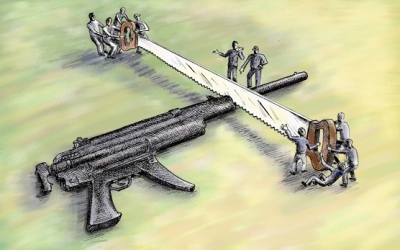
The debt ceiling deal will cut $1 trillion out of the defense budget, $600 billion of which would be cut automatically across-the-board, slashing funding for trauma gauze for Army medics just as much as ballpoint pens for Pentagon bureaucrats. It’s like Congress is cutting the budget blindfolded — the type of absurd policy that belongs in a Hollywood farce, not Washington’s reality.
Yet, as a share of all federal spending, the Pentagon budget accounts for just 16 percent, compared to its 40 percent high during the Vietnam War. Investment in replacement equipment as well as new military technologies is also at a relative low 1.3 percent of GDP, accounting for just a quarter of all defense spending. Modernization programs and Pentagon bureaucracy have been cut in recent years by hundreds of billions of dollars.
Under the debt ceiling deal defense cuts, Defense Secretary Leon Panetta predicts that the Army would shrink to its lowest level since before World War II, the Navy to pre-World War I levels, and the Air Force to its smallest size ever. Meanwhile, the world isn’t getting any safer. China is building fifth-generation fighter aircraft and a fleet of aircraft carriers to challenge the U.S. in the Pacific and Al Qaeda is growing in Yemen.
Our own national security is at stake. National Intelligence Estimates predict that countries including North Korea and Iran could be capable of hitting a U.S. city with a nuclear ballistic missile within just a few years. While current missile defenses protect us from today’s threats, rogue countries are working with China, Pakistan and Russia to build bigger missiles and add more sophisticated countermeasures.
The cost of continuing to improve our missile defenses is a miniscule fraction of one percent of all federal spending. The price of letting our guard down and allowing a major U.S. city to be wiped off the map is immeasurable.
Congress needs to remove the blindfold and consider the real consequences of cutting too deeply into our national defense. Now is the time for decisive leadership by both our military and political leaders.
GREG SLAVONIC, of Oklahoma City, is a retired rear admiral in the U.S. Navy.
Source: http://www.edmondsun.com/opinion/x2145128266/Defense-cuts-threaten-national-security


